
Deed Types Recorded in Paulding County
The Clerk of Superior Court Real Estate Division receives, indexes and records every real-estate instrument filed in Paulding County. Its docket names several distinct deed forms, including Administrator's, Cemetery, Executor's, Quitclaim, Security and Warranty deeds.
| Deed Type | What It Does | Common Use |
|---|---|---|
| Warranty deed | Conveys the described interest with stated warranties | Ordinary arm's-length transfer |
| Quitclaim deed | Conveys whatever interest the grantor holds | Family or title-cleanup transfer |
| Administrator's / Executor's deed | Conveys through an estate representative | Probate-related transfer |
| Security deed | Secures debt against real property | Financing record, not a sale deed |
| Cemetery deed | Documents a cemetery-lot interest | Specialized recorded interest |
A conveyance deed and a security deed do different work. Both sit in the same Paulding index. Liens, releases, easements and covenants can also burden a parcel without ever changing who the owner of record is, so read past the names on any deed.
Use the Paulding Real-Estate Index Fields
The GSCCCA Real Property system carries the deed-docket indexes and images. Searchers can query by grantor or grantee, book and page, instrument type, street address, map, or PT-61 conveyance detail, and scope the search to Paulding County or wider. Full web access may require a subscription. Public terminals offer another route.
| Index field | What to capture | Why it matters |
|---|---|---|
| Grantor / grantee | Exact indexed spelling and role | Connects one transfer to the next |
| Instrument type | Deed, lien, plat or other filing | Separates conveyance from encumbrance |
| Recording date | Date accepted into the record | Orders the public trail |
| Book/page or instrument | Permanent document reference | Retrieves the indexed image or copy |
| Location / PT-61 | Description, sale data where available | Reconciles the party hit to the parcel |
Field labels and redaction practices live in the system itself. Check the current GSCCCA interface for how Paulding results display.
The 1995 Online Line for Paulding Deeds
Paulding County states that deed records and UCCs from January 1, 1995 onward are available through GSCCCA, while GSCCCA dates its statewide real-estate project to January 1, 1999. Those are separate facts. One is the county's stated coverage threshold. The other is the statewide system's operational history.
Older Paulding County deed records live in courthouse deed books and microfilm. When a chain gets difficult, extend it through the Georgia Archives deed search or other archival aids. Discovery copies never substitute for a Clerk-certified one.
Note: No reliable official source was found for a courthouse-fire gap, so do not assume one.
Walk the Paulding Grantor-Grantee Chain
A sound chain starts with an identified parcel, never a matching surname alone. Pull the current owner, GPIN, legal description and any deed reference from the assessor or the property search first. Only then enter the deed index.
- Find the current owner's acquiring deed with that owner in the grantee role.
- Copy its grantor, recording date, document type, book/page, description and prior reference.
- Search that grantor as a grantee in an earlier conveyance, testing initials and entity variants.
- Repeat while the legal description continues to identify the same tract; move to deed books when online coverage ends.
- Grantor
- The party transferring the stated interest.
- Grantee
- The party receiving the stated interest.
- Chain of title
- The linked sequence of conveyances for the same land.
- Book/page or instrument number
- The Clerk's locator for a recorded filing.
Match a Deed to the Right Paulding Parcel
Names are weak identifiers in Paulding County. Match the subdivision, lot and block, land lot, district or section, acreage, adjoining owners, plat reference and the prior deed reference before trusting any hit. A new subdivision account may descend from a parent tract. It can carry fewer historic names than the older deed.
Search name variants too: married names, initials, "et al.," trustee, estate, heirs, administrator or executor. An LLC name can be checked in the Georgia business search. But an entity record alone never proves parcel ownership.
Read Plats and Encumbrances Beside the Deed
The Clerk's office records far more than deeds. Easements, plats, covenants, declarations and liens all sit in the docket. So do assignments, modifications, releases, powers of attorney, subordinations and timber agreements. A clean-looking chain can still carry a separate access easement or an unreleased lien.
Read plats beside the deed. Use the plat book and page in the GSCCCA plat docket. A plat shows lots, roads, rights-of-way and easements. It does not prove every lot was conveyed, and a GIS polygon is not survey-grade evidence.
Note: Review both conveyances and related instruments before drawing a conclusion from Paulding County deed records.
Old Paulding Land May Lead Beyond Today's County
Paulding County was created from Cherokee territory in 1832. Its nineteenth-century boundary changes involved Carroll, Cobb, Floyd and Polk lands. An early deed chain can therefore continue in a predecessor or neighboring county. The tract's date and location will tell you where to look.
When an old deed predates numbered addresses, rely on land lot, district, acreage, plat and adjoining owners. The Georgia DCA property-history guide maps out courthouse, Archives, microfilm, tax-digest and land-grant routes. Treat archival evidence as a clue until it reconciles with the recorded description.
Order a Paulding County Deed Copy
The Clerk of Superior Court sits at 280 Constitution Boulevard, Room 1023, Dallas, GA 30132, reachable at 770-443-7527, Monday through Friday, 8 a.m. to 5 p.m. Bring party names, an approximate date, and a book and page or instrument number. Fees effective July 1, 2025 are $1 per page for a standard uncertified copy, or $2.50 for the first certified page plus $0.50 for each additional certified page.
Online images depend on GSCCCA access. A certified electronic copy can be requested through the Paulding eCertification instructions. Mail and counter requests still work well when an image is missing or a subscription does not fit.
Recorded, not guaranteed. The index shows what the Clerk accepted and indexed; it is not a title opinion and does not rule out an unrecorded interest or indexing problem.
Free Filing Alerts Add a Monitoring Layer
Georgia FANS sends free alerts for real-estate filings tied to registered names. An owner can learn quickly when a new indexed instrument warrants a look. GSCCCA does not promise complete or accurate detection. The service cannot prevent title fraud. Visit the FANS enrollment screen before choosing which name variations to monitor.
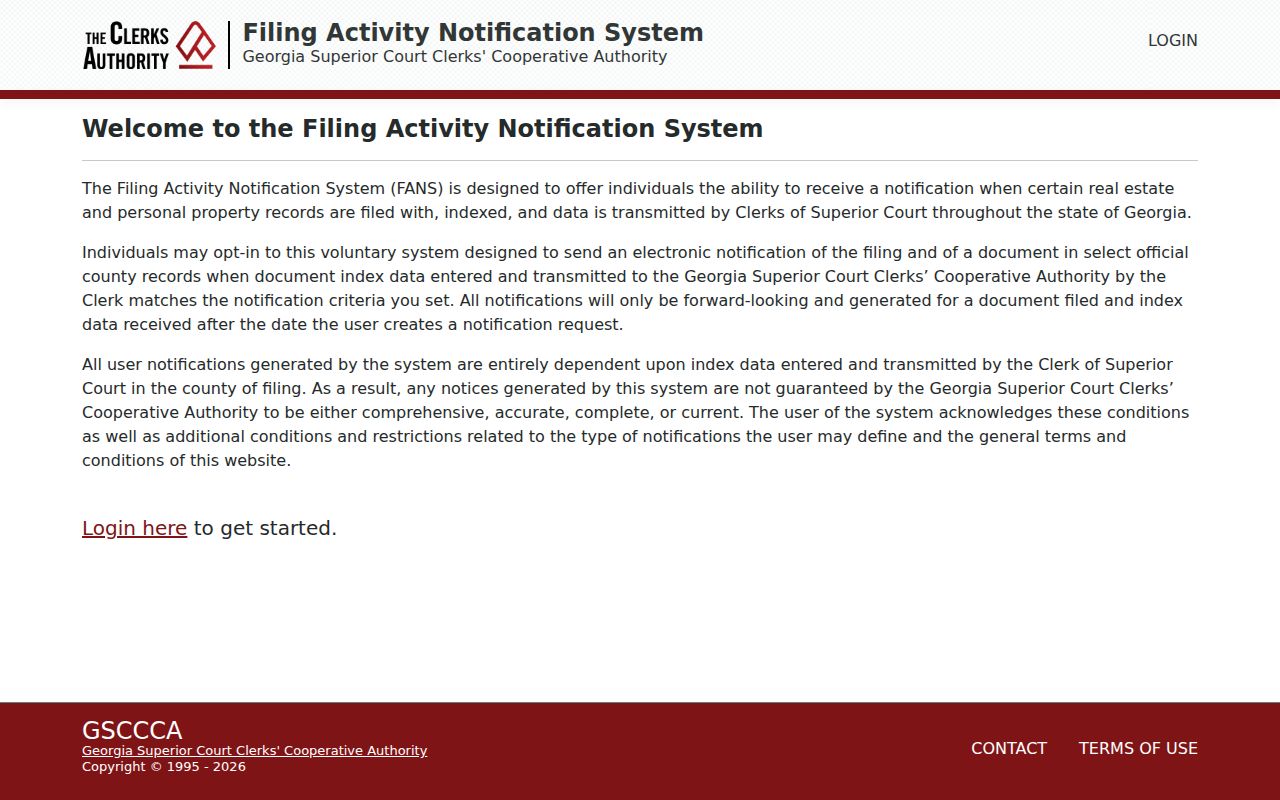
The FANS service is only an alert channel. It says nothing about whether any Paulding deed is valid. Verify every notice against the Clerk's index and the recorded image.
Build a Complete Paulding Instrument Worksheet
Log every deed-index hit fully. Capture grantor, grantee, role, instrument type, and recording date. Note the book and page or instrument number, county, and legal-description clue. Add the cross-reference, any PT-61 or sale-price data where present, and whether an image can be viewed. Then run an encumbrance pass. Cover security deeds, assignments, modifications, cancellations, federal and state tax liens, judgments, mechanic and materialman liens, hospital liens, easements, covenants, powers of attorney, subordinations, and plats.
Track a status for each item. Use index located, image viewed, login required, courthouse-only, certified copy requested, date searched, and source system. The distinction matters. An index entry with no online image is still a useful lead. An image viewed through a subscription never becomes a certified Clerk copy. It just looks official.
Use the Assessor as a Crosswalk, Not Title Proof
The assessor card can supply owner name, mailing and situs addresses, GPIN, legal description, acreage, values and a transfer reference. It is the fastest way to tie a street address to deed-search clues, but Paulding's January 1 valuation rule means a newly recorded conveyance may not yet appear in the current digest. Search the newest grantee in the Clerk's index whenever timing matters.
If a post-January-1 deed differs from the tax roll, preserve both dates instead of declaring one source erroneous. The deed addresses the recorded conveyance; the digest addresses assessment administration for its stated year. This source distinction is especially important for estates, trusts, entity transfers, parcel splits and parent tracts.
Follow a Paulding Deed's Prior References
A Paulding County deed rarely repeats every detail from scratch. It may pull in an earlier description, plat, easement, or parent-tract conveyance. The reference is by book and page instead. Copy each cross-reference. Pull the referenced instrument before working further back. Then compare land lot, district or section, acreage, subdivision, lot and block. Check adjoining owners and survey calls too. One caution: a single grantor can convey several unrelated tracts. A matching name and date alone prove nothing.
Plat references open another door. Search the GSCCCA plat docket and the Clerk's records. Use plat name, county, book and page, and instrument type. Security deeds and cancellations deserve their own separate trail. A release satisfies a lien without conveying land. An assignment moves a lender's interest while leaving the owner of record untouched. Keeping encumbrances apart from the ownership chain prevents the most common deed-reading mistakes.
Ask the Paulding Clerk for a Targeted Search
When the online image or an older index is out of reach, the Paulding Clerk can still help. Ask the office to run a targeted search. Give the office a compact package. Include grantee and grantor names, approximate recording date, deed type, known book/page or instrument number, GPIN or account, street and former address, subdivision and lot, land lot and district, acreage, and the copy type you want. The courthouse terminal and the deed books are simply different access channels. Neither one proves a missing web hit was never recorded.
The Georgia Open Records Act supports your request. Ask for the existing local index entry or image. Also request an estimate when retrieval or copying may be substantial. For ordinary research, an uncertified copy works fine. Choose a certified or eCertified copy when an official process demands one. One limit stays firm. The Clerk cannot give legal advice or declare a chain clear. That judgment belongs to a qualified title professional or attorney.